Skip to content

About the project

Language modelling for protein (mis-)folding pathway dynamics

Protein folding dynamicsGenerative AI modelMisfolding divergence detectionProtein language modelNeurodegenerative diseasesTrajectory-based biomarkersFAIR molecular dataDigital health research

Protein folding is one of the most consequential molecular processes in biology. It determines whether a polypeptide chain reaches its native, functional conformation or diverges into a structurally aberrant state that causes disease. Instead of adopting a fixed shape immediately, a chain navigates a rugged, multi-dimensional energy landscape shaped by metastable intermediates, kinetic traps and competing transition routes before it settles into a stable native state or a misfolded configuration. The order, timing and cooperativity of structure formation along this trajectory decide folding efficiency, the stability of intermediates and the susceptibility to aggregation.

In amyloid-forming proteins such as amyloid-β, tau and α-synuclein, early off-pathway conformations trigger the nucleation and spread of toxic oligomeric aggregates years or decades before neuronal damage becomes detectable. An estimated 9.1 million people in Europe live with dementia, projected to rise to 14.3 million by 2050. Despite transformative progress in static structure prediction, this dynamic dimension of protein biology remains computationally inaccessible at scale.

PathFold closes this gap by developing a generative framework that learns and predicts how proteins fold and misfold over time directly from their amino acid sequences. Rather than predicting a single final structure, PathFold models the folding process as a coarse-grained, kinetically ordered sequence of structural transitions and captures the order, timing and interdependence of the conformational events that govern stability. Because direct experimental folding trajectories exist only for a limited set of small model proteins, PathFold combines them with indirect kinetic observables (HDX-MS protection factors, NMR conformational ensembles) and energy-informed surrogates into a tiered supervision signal.

The framework consists of three complementary components: the trajectory generation model PathFold-P, the probabilistic misfolding detection model PathFold-M, and the PathFold-Toolbox with the DynBench benchmarking framework.
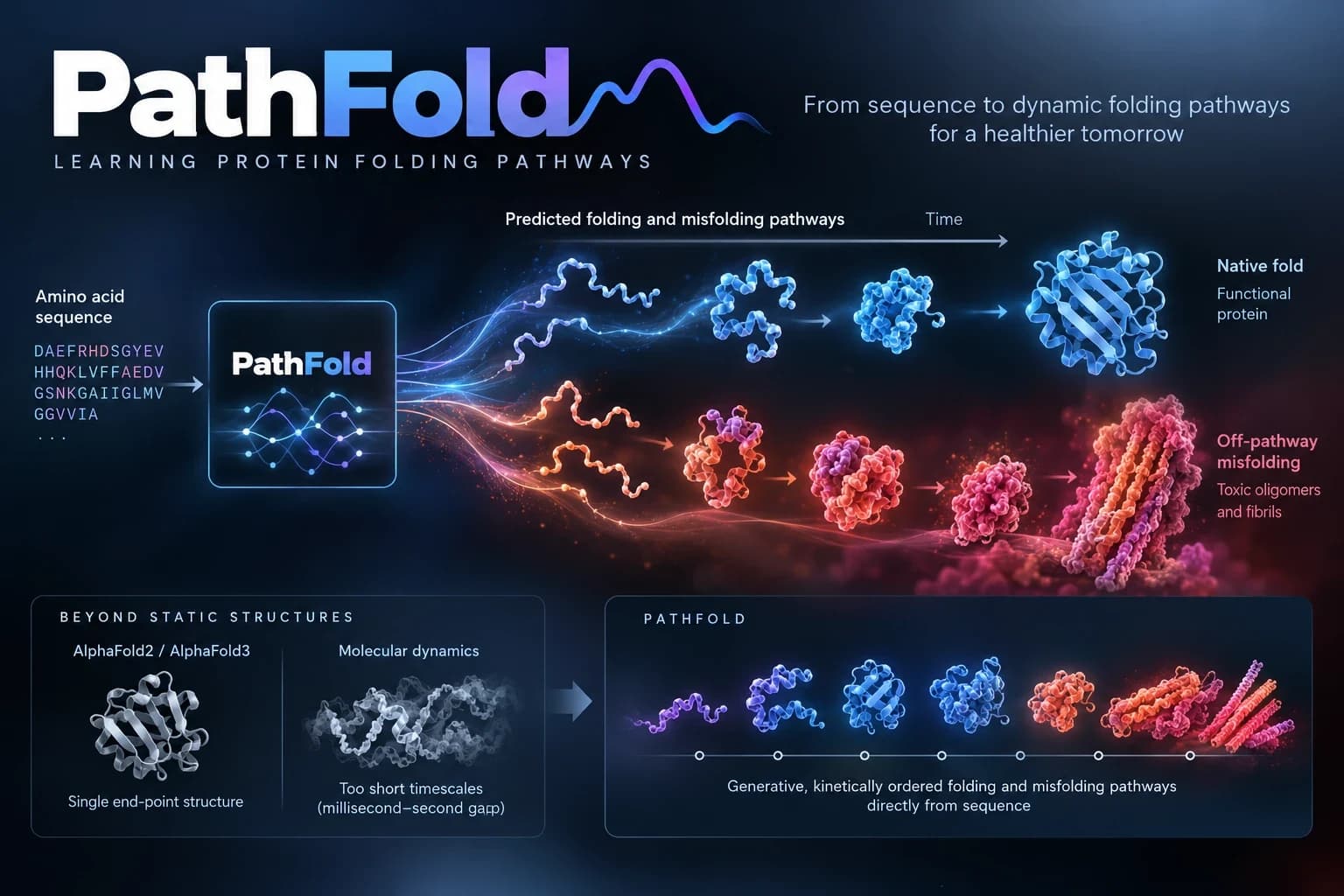
PathFold overview infographic
From sequence to dynamic folding pathways: productive folding towards the native state (blue) versus off-pathway misfolding into toxic oligomers and fibrils (red).

Scientific objectives

Two research questions, two hypotheses

RQ1

Why do current structure prediction models fail to capture folding pathways from amino acid sequences?

Structure predictors return static end states and discard the temporal order and energetic continuity of folding. PathFold addresses this with a tiered supervision signal: Tier 1 uses long all-atom MD trajectories of fast-folding proteins and Folding@home subsets discretised with Markov state models; Tier 2 integrates experimental observables (NMR ensembles, HDX-MS protection factors, Φ-values) as partial ordering constraints; Tier 3 provides physics-informed regularisation through Gō-type energy functions, contact-order folding-rate estimates and statistical contact potentials.

RQ2

How can generative models predict misfolding divergence to identify sequence regions responsible for aggregation and instability?

Existing aggregation predictors rely on hand-crafted physicochemical features and reach roughly fifty percent accuracy on diverse protein families. PathFold treats misfolding as a divergent trajectory in the same latent space used for folding prediction. Learning from both stable and unstable sequence–trajectory pairs, it estimates the probability of deviating from low-energy pathways and identifies residue clusters or mutation hotspots linked to aggregation-prone behaviour.

Hypothesis H1

Trajectory signatures provide molecular indicators of early instability that support variant prioritisation, aggregation risk assessment and the identification of mechanistic targets for therapeutic intervention.

Hypothesis H2

Such a framework is a data-driven kinetic surrogate that delivers clinically relevant folding and misfolding information orders of magnitude faster than MD simulations, without requiring existing structures or MD trajectories as input.

Project success will be measured against

  • PathFold-P reconstructs the experimentally documented folding order of established fast-folder benchmarks (Chignolin, Trp-cage, WW domain) with monotonic energy descent, mean RMSD continuity below a predefined threshold and demonstrable agreement with NMR and HDX-MS intermediate states.
  • PathFold-M outperforms established sequence-based aggregation and disorder predictors (TANGO, Zyggregator, PASTA2) and recent data-driven models in residue-resolved precision/recall and AUC on independent test sets from DisProt, AmyLoad, AmyPro and ClinVar, with calibrated uncertainty.
  • A curated, FAIR-compliant sequence–trajectory dataset (P-Track and M-Track) harmonising PDB, AlphaFold DB, UniProt, BMRB, DisProt, AmyLoad, AmyPro, ClinVar and Folding@home is released as an open resource together with DynBench, the PathFold-Toolbox and a public leaderboard.

Exploitation & outlook

Roadmap

2027

  • Dataset release: P-Track and M-Track v1.0, FAIR-compliant via ELIXIR-DE and NFDI4Health
  • Goal: one harmonised sequence–trajectory–annotation resource as the foundation for both models

2028

  • Model release: PathFold-P v1.0, the folding trajectory model
  • Benchmark release: DynBench v1.0 with a public leaderboard
  • Goal: kinetically ordered, energy-consistent trajectories that agree with NMR and HDX-MS intermediates

2029

  • Model release: PathFold-M v1.0, the misfolding and aggregation model
  • Release: PathFold-Toolbox with Python SDK, CLI and REST API
  • Dataset release: Alzheimer benchmark subset for amyloid-β, tau and α-synuclein
  • Goal: variant-resolved dynamic misfolding maps for neurodegenerative proteins

2030+

  • Goal: extend PathFold to multi-protein aggregation and post-translational modifications
  • Goal: clinical validation of trajectory-based misfolding risk scores
  • Continued DynBench and dataset releases for the community

Open science & ethics

FAIR by design, open by default

  • All models, datasets and analysis outputs are curated according to the FAIR principles and published with metadata, versioning and provenance documentation following ELIXIR-DE and NFDI4Health standards.
  • PathFold-P, PathFold-M and the PathFold-Toolbox are released as open-source software; P-Track and M-Track as versioned open datasets; DynBench as an open benchmarking platform with a public leaderboard.
  • The project uses exclusively publicly licensed molecular and sequence resources. No human, animal or patient-identifying data are processed.
  • PathFold is an analysis framework for naturally occurring sequences: it does not generate novel protein sequences with designed functions. Outputs are descriptive molecular descriptors, not synthesisable constructs.

Consortium

Partners

PathFold is funded by the German Federal Ministry of Research, Technology and Space (BMFTR) under the “Zukunft eHealth” funding guideline (grant no. 031L0342).